










































Child-Friendly Schools Case Study: China
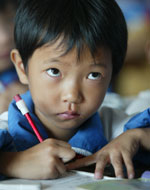
From the United Nations Children's Fund (UNICEF), this case study explores UNICEF China's child-friendly schools (CFS) project, which was initiated in 2001 in an effort to: expand inclusive education for children from disadvantaged groups; provide safe and protective learning environments; improve the capacity of all stakeholders in implementing a rights-based approach to quality education; improve professional teacher competencies; strengthen school-family-community partnerships; and foster children's participation and well-rounded development. The purpose of this case study is to document the Chinese experience with CFS and its policy impact at the national level, as well as to demonstrate the results of its implementation at the local level. It also analyses the remaining challenges of the CFS model of quality education in action and lessons learned from the CFS implementation process.
The opening sections of the case study describe: the role that education plays in the national development of China; challenges (e.g., the "major" rural-urban disparity that exists in terms of teachers' qualifications, facilities, and infrastructures); and the current situation with regard to educational policy. Statistics (e.g., education enrolment rates) are also included.
As detailed next, the CFS programme in China was designed - in the light of the Convention of the Rights of the Child and of China's national education policy to - ensure "inclusive enrolment and equal treatment of all school-aged children, in safe, healthy and protective environments, promotes learners’ actual acquisition of relevant knowledge, capacities and attitudes through relevant life skills-integrated curriculum and effective teaching, and strives for democratic participation of all pupils, teachers, the family and the local society, making the school a harmonious learning community."
Specifically, the project involved teacher training as an "entry point" in integrating the child-centred concept into classroom teaching in the pilot regions. (In 2001, the CFS pilot was started in 12 rural township primary schools in 7 counties of 3 provinces: Guangxi Zhuang, Inner Mongolia, and Chongqing). This training focused on promoting the care of and respect for children, improving pupil-teacher relationships, and making schools and learning environments more child-focused. CFS assessment instruments and checklists were developed by national experts in consultation with pilot schoolteachers and principals. In 2003, the CFS approach to child-centred learning was integrated into a national teacher-training programme, which stressed learner-centred, participatory teacher-pupil interaction in classroom teaching and learning. The CFS teacher training manual and CFS principals training manual were printed and used in training activities. In 2004, the Ministry's Teacher Education Department, the UNICEF Office for China, and the Beijing Academy of Education Sciences jointly published a book entitled "Children Say What Makes a Good Teacher" - described here as "an original collection of children's views on teachers..." By 2005, the CFS approach to child-centred learning had expanded its activities.
Information about the outcomes of the project is provided; for example:
- "CFS pilot schools have increased their net enrolment rates to 100 per cent, without dropouts for boys or girls, and with awareness for equal care and respect inculcated in both teachers and students."
- "The CFS project was assessed as being one of the best examples of gender mainstreaming..."
- "Capacity of schools, teachers, local community and government offices [was] enhanced to plan, implement and monitor interventions of the project for the realization of children's rights..."
- "As a result of project implementation, all CFS pilot schools are reported to have been more open and participatory in community development, sharing educational resources with local people and making school a learning community..."
- "Children's participation has been facilitated in the teaching-learning process and decision-making, and the well-rounded development of children has been promoted at CFS pilot schools at a much higher level than in non-pilot schools and communities..."
- Progress was made toward the development of a national framework of CFS dimensions and standards.
Lessons learned from the implementation process are outlined. Highlights include:
- Set goals in the light of national development context.
- Use a strategic approach that involves: model building (incorporating elements of inclusiveness, equality, child-centredness, gender sensitivity, participation, effective teaching, and school-family-community partnership); standards setting; capacity building; inter-departmental and multi-sectoral coordination; and service delivery.
- Adapt the CFS concept to nationally/locally-specific contexts.
- Build the capacity of policymakers and educational practitioners at different levels.
- Ensure that CFS concepts reflect traditional Chinese cultural values.
- Foster strong organisational leadership and inter-project, central-local, and inter-departmental coordination.
Finally, future directions related to the CFS project in China and its policy impact at the national level are described, followed by vignettes that illustrate the project's impact on children and others.
UNICEF website and UNICEF China website - both accessed on February 11 2011. Image credit: © UNICEF/China/Liu Yu

- Log in to post comments