










































Amani Peoples Theatre (APT)
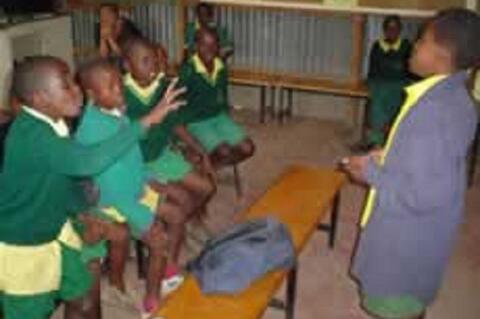
Amani Peoples Theatre (APT) is an organisation that brings together volunteer trainers to use their talents, skills, and experiences to employ interactive participatory theatre for conflict transformation, peace-building, and development in Kenya. The APT process integrates education, entertainment, and research in exploring context specific issues related to conflict and development and enhancing the community's search for creative, non-violent responses.
Communication Strategies
The project objectives include to:
- promote dialectic dialogue with an emphasis on critical reflection through understanding and active participation in a communicative environment. This is done with traditional African philosophical thought and communication processes in mind.
- facilitate the process of sharing of experiences by encouraging collaborative reflection by way of inter-community artistic exchanges and documentation of experiences.
- build the capacity of community leaders and other individuals in positions of power and governance to become peace and development practitioners by creating the space in which an outline of the responsibilities, powers, processes and limitations of the central and local governments are understood and judged.
- sharpen, through the use of peoples theatre, the ability of community leaders and other local opinion shapers to critically analyse conflicts and devise alternative and joint approaches to peace building and peaceful transformation of conflicts.
- identify the cultural traits which keep on producing conflict among different Kenyan communities and preventing peace, and re-establish a working relationship between the conflicting communities and peoples.
The APT activities include:
- People’s Theater Workshops:
These are 2-day non-residential workshops. The invitations are open to all community members but are restricted to a maximum of 40 participants per workshop. These participants are selected by the community based organisations that APT works with at the grassroots. The participants are encouraged to explore pertinent issues in their communities. - Community Based Action Research:
These are community based training sessions with a very strong research component. APT facilitators become resident in selected communities for a period of no less than 7 days every two months. During this time, the APT facilitators carry out Conflict Transformation and Peace-building trainings with a selected group of Community Animators in the village. Further, APT facilitators participate in the activities of the community and gather data for the action research project. A member of the Programmes Monitoring and Evaluation team from the office visits the facilitators for at least 2 days for purposes of monitoring.For the period that the facilitators are resident in the village, they are charged with the following tasks:
- Work with the community to come up with the community’s peace agenda.
- Seek an understanding of the cultural practices and identify those that enhance or abate conflicts.
- Together with the community, identify resources within the community that can enhance the process of peacebuilding and conflict transformation.
- Work with the community and their leaders to put in place early warning mechanisms to support the peacebuilding processes.
- Prepare detailed documentation of experiences in the community with the aim of developing them into case studies for reflection.
- Using the experiences gathered, prepare artistic pieces reflecting the communities’ aspirations and understanding of conflict.
- Training Community Animators:
These are organised either as residential training workshops held at a venue near the community, or where the situation demands, as non-residential community based training sessions. The target is 15 participants from within the community. These participants must be in a position of leadership / governance within the community and must include women, youth, and the disabled. The animators are trained in, among other things: conflict transformation and peace building, community leadership, group formation and group dynamics, community organising, non-violence, people’s theatre, micro-finance, and small enterprise management. - Reflection on Community Experiences:
These are residential workshops organised at a centre close to the community. They target community members and their leaders in communities that have experienced overt conflicts as well as those that are in the latent stage. - Healing and Rehabilitative Arts/Drama Therapy:
These are conducted for special groups such as refugees, victims of domestic violence, vulnerable children and orphans, internally displaced persons, and children in remand prison. In order to enhance healing and reconstruction, the participants are brought together in a workshop. The participants are encouraged to reflect on their own situation and seek ways of dealing with existing as well as emerging challenges. Issues on restorative justice are also explored especially with the children in remand prison, as well as with the victims of violence. - Documentation and Publication:
APT is involved in the collection and analysis of data from the different programme activities and other sources for the purpose of publication. APT has produced publications that enhance arts approaches to peace building and conflict transformation. It has published two books:- From Playing to Learning to Change: Theatre in Conflict Transformation and Peace Building, by Amollo Maurice Amollo
- Reflections On Impact Assessment Indicators: Issues in the Arts and Peace Building, by Amollo Maurice Amollo & Babu Joseph Ayindo
Development Issues
Conflict, Youth, Women, Children.
Sources
APT website on November 24 2006 and January 18 2013.
- Log in to post comments