










































Adopting Healthy Maternal and Child Survival Practices in Rural Ghana: Eight CRS Maternal and Child Health Innovations
“When a mother chooses to deliver her baby outside of formal health facilities, she puts her own life and that of her newborn baby in jeopardy, particularly if complications arise.”
This implementation guide provides details of eight Catholic Relief Services (CRS) maternal and child health innovations implemented as part of the Encouraging Positive Practices for Improving Child Survival (EPPICS) project, a four-year child survival project in Ghana. As explained in the guide, these community-based innovations led to numerous statistically significant increases in maternal and child health (MCH) indicators and contributed to moving community members away from harmful rural health practices and toward the use of formal health services. It is hoped that development workers and health professionals, including local and international organisations, will use the guide to increase their familiarity with these high-impact strategies and consider them for use in other child survival projects seeking sustainable improvement in MCH in rural settings.
Part 1 of the guide shares an overview of the intervention in East Mamprusi district in northern Ghana, as well as some of the project’s impacts. In brief, the EPPICS project “aimed to contribute to sustainable maternal and newborn morbidity and mortality reduction in East Mamprusi district by 2015. The project’s two primary strategic objectives were to improve maternal and neonatal health outcomes and increase access to quality maternal and neonatal services for all families in the district. The project design - determined in collaboration with Ghana Health Service [GHS], research partner University for Development Studies (UDS) and community stakeholders - coupled improvements in delivery of facility-based health services with innovative community-led strategies to close the gaps preventing care-seeking at the community and household levels.” In terms of impact, the guide highlights that, “during the project timeframe, East Mamprusi advanced from being the worst-performing district in the Northern Region in 2010 to the best-performing district overall in the region in 2014 and the best-performing district for MCH indicators in 2015. Institutional maternal mortality reduced 131 percent from 295 deaths per 100,000 live births in 2011 to 81 deaths per 100,000 live births in 2015, with skilled assisted deliveries increasing from 43 percent at baseline to 76 percent at endline.”
Part 2 of the guide presents a summary of EPPICS project administration, including details of: the project design; coordination with key partners; project surveys and research; an organisation chart; a high-level implementation plan; and monitoring, evaluation, accountability, and learning activities, including a pilot project to transmit health facility data more efficiently using iPad minis.
Part 3 introduces each of the eight CRS MCH innovations, sharing the following information for each innovation: problem faced; strategic solution; resulting outcomes; implementation steps; key challenges; suggested best practices; and real-world examples from project staff, GHS staff, community partners, and beneficiaries. The innovations described in detail in the guide are as follows:
- Partner engagement: The EPPICS project was led by GHS and relied on extensive community involvement for lasting sustainability, with CRS serving in an advisory and facilitative role.
- Capacity building: Numerous trainings and continual mentoring increased the capacity of GHS district officers, frontline health workers, and community volunteers, who became personally invested in the project’s success.
- Councils of Champions: EPPICS invited community elders and leaders, who serve as the custodians of socio-cultural, traditional, and religious practices, to form MCH councils to discuss health issues, determine needed behaviour changes, and use their strong community influence to sway public opinion and behaviours toward healthier beliefs and practices. The expectation was that modifications of traditional practices would be much more likely if initiated by these highly influential council members. As an example, one key belief that councils helped to change is the traditional idea that breast milk doesn’t contain water so infants will die of thirst if they are not given water. Councils of Champions explained to community members that breast milk does contain water in addition to other substances and nutrients that strengthen an infant’s immune system and promote the greatest growth.
- Traditional birth attendants (TBAs) repositioned as link providers: The project trained TBAs to serve instead as link providers responsible for linking pregnant women to health facilities for MCH services and for helping women in labour to get to the nearest health facility to reduce home births and resulting maternal and neonatal deaths.
- Modified motor tricycles as rural ambulances: Four modified motor tricycles provided 20 of East Mamprusi’s most isolated communities with readily available transportation to the local health facility for women in labour and their link providers, increasing access to health facilities for skilled assisted deliveries and subsequently reducing deaths occurring from home deliveries.
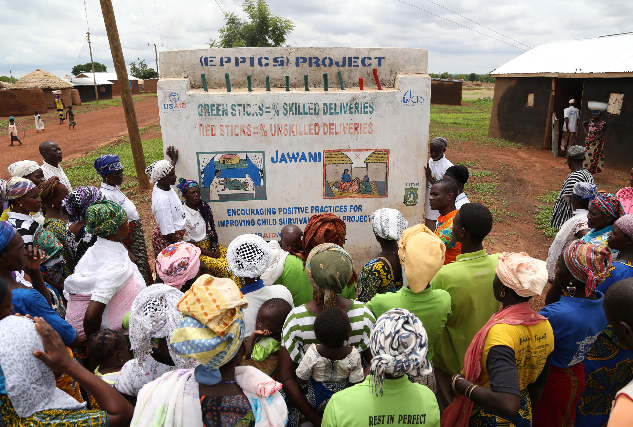
- Community giant scoreboards: Community participation is essential for improving MCH, but motivating communities to remain focused on MCH outcomes can be a challenge. Large walls built in prominent public spaces in each of the 240 communities served as visual awareness-raising tools that rally residents by publicly tracking community performance against key MCH indicators.
- Community pregnancy surveillance and education sessions: EPPICS recruited model mothers to lead education sessions for pregnant women and nursing mothers to promote early antenatal visits, institutional deliveries, postnatal care, and appropriate infant and young child feeding practices. Model mothers are positive-deviant women who follow recommended MCH practices.
- Mentoring health facility staff: Six mentors visited each of the 12 health facilities in East Mamprusi district to provide hands-on coaching and mentoring to less experienced health staff to increase their knowledge and skill levels.
Part 4 of the guide describes plans for expanded use of these innovations. For example, due to the documented achievements of the EPPICS project, Ghana Health Service and CRS are rolling out EPPICS innovations in other districts and regions in Ghana in hopes of achieving similar MCH outcomes. CRS has also incorporated community giant scoreboards into child survival programmes in three other countries.
The guide concludes with a list of lessons learned, which include, but are not limited to, the following:
- Place the Ministry of Health as the lead implementing partner to maximise resource use, capacity building, and long-term sustainability, with project objectives complementing broader national health goals.
- For project sustainability in rural areas, involve community members in project design, implementation, and monitoring to promote positive behaviour changes and increase their commitment to continuing key activities after project end.
- Advocate for increased investment in the rural health infrastructure to increase availability of formal health facilities in remote areas, reducing travel times for clients.
- Engage custodians of practices, rituals, attitudes, and beliefs as Councils of Champions for MCH, which is a highly effective strategy for modifying harmful cultural practices and beliefs and introducing new positive health-seeking behaviours.
- Erect giant community scoreboards placed in common public areas to motivate community members to take action to improve MCH outcomes by presenting performance against key indicators in an engaging, pictorial way.
- Use high-quality construction materials and simple visual designs when building community giant scoreboards to increase durability and reduces maintenance needs. (The scoreboards should also be built during dry periods.)
The guide is accompanied by a learning brief, Improving Maternal and Child Survival in Rural Ghana: Eight CRS Maternal and Child Health Innovations, which provides a summary of the project's innovations and outcomes.
CRS website on November 8 2016.
- Log in to post comments