










































The Uni
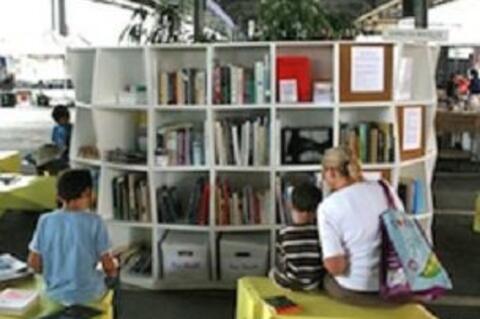
A project of Street Lab, Inc., a United States (US)-based nonprofit organisation, the Uni is a portable, open-air reading room that puts books and learning experiences such as readings, classes, and screenings where they might not otherwise be accessed in an urban environment. Launched on September 11, 2011 in New York City (US), the Uni is designed to be a tool for addressing many of the challenges American cities are facing. It can be installed in various configurations at different scales, with the goal of transforming areas within parks, plazas, or empty lots into places of community use, learning, and public engagement.
With the purpose of carving out space for books and learning and putting them on a kind of stage, the Uni utilises using new tools and technologies to create a system for use in public space. The Uni consists of 3 basic components: a structure, a collection, and a team.
- The Uni starts with a custom-designed infrastructure that can be adapted to almost any kind of urban space. It consists of 144 open-faced cubes, which can be stacked and locked together in different configurations or heights. Each Uni cube measures approximately 16” on a side and provides shelf space for approximately 10-15 books or other materials. Each cube has a cover that can create a bench, a table, podium, or a display surface. Together these cubes provide a modular system for programming public space and creating a venue for books, workshops, arts-and-crafts, demonstrations, classes, lectures, public meetings, and small film screenings. In the early evening or in bad weather, these cover elements can be re-inserted to close up the Uni and transform it into a new form; overnight, the Uni can be further secured with a locking, waterproof cover.
- The Uni collection consists of new and gently-used books and materials donated to the Uni. Managed with the help of a team of volunteer librarians, the goal is to offer an engaging collection of books and learning experiences to an urban audience. The collection is organised into modules that help librarians adapt the Uni to different locations and communities, and even change content over the course of a day. Materials in the Uni are for browsing only and do not circulate. Areas of focus are children's picture books, poetry, short works, art books, and reference titles.
- The Uni relies on a volunteer corps of librarians, educators, and others. Off-site, they work with project staff on site selection, permitting, scheduling, outreach and publicity. On-site, they focus on programme implementation, audience experience, and documentation.
For further details, visit the Uni website.
Education.
According to Street Lab: "Book stores are closing. Public libraries are struggling. Electronic communication, video games, and online socializing are sapping more and more of our attention. Many urban residents, especially children, do not have access to books and places to read them outside of schools. We seem to be losing touch with books at the very moment, and in the very places, we need them the most....Cities need new solutions that do the work of libraries and community centers but are lighter-weight, more flexible, less expensive to operate, and better integrated into our patterns of daily life. The Uni anticipates a future when cities become still more dense, space even more expensive, and rapid social and technological change are the norm. The Uni also recalls a past when we gathered around to hear the news, absorb a story, or learn a skill from another person."
The Uni stems from another Street Lab project, the Storefront Library (please see "Related Summaries" below to read more about that project).
Email from Leslie Davol to The Communication Initiative on July 30 2011; and "The Uni: A Portable, Open-air Reading Room for Public Space" and Uni website - both accessed on November 23 2011.
- Log in to post comments