Child rights action with informed and engaged societies

After nearly 28 years, The Communication Initiative (The CI) Global is entering a new chapter. 

Following a period of transition, the global website has been transferred to the University of the Witwatersrand (Wits) in South Africa, where it will be administered by the Social and Behaviour Change Communication Division. Wits' commitment to social change and justice makes it a trusted steward for The CI's legacy and future. 

On the transfer, co-founder Victoria Martin expressed her pleasure to see this work continue under Wits' leadership, knowing that co-founder Warren Feek (1953–2024) would have felt deep pride in The CI Global's Africa-led direction. 

As Wits, we honour the team and partners who sustained The CI for decades and look forward building from that strong base. This includes co-founders Warren Feek (1953-2024) and Victoria Martin as well as La Iniciativa de Comunicación (CILA), which continues independently at lainiciativadecomunicacion.com with links to The CI Global site. We are also eager to forge new partnerships and entertain new ideas as we consider how best to contribute to social and behaviour change in our rapidly evolving environment.

If you are joining the International Social and Behaviour Change Communication (SBCC) Summit in Panama, please join Wits and CILA on Monday, 22 June, to share your thoughts and suggestion for the relaunch of the Communication Initiative. We will be in Pacifica 5 from 12-1:25 for the Refuel, Reflect, and Renew Lunch Series: The Communication Initiative: celebrating a driving force for Communication for Social Change and the way forward. We will reflect on the legacy of Warren Feek and family in creating the Communication Initiative, consider the contributions of CI over the years and then turn our attention towards the future in this dynamic session. 

If you are unable to join us in Panama, we still want to hear from you. Please contribute your thoughts by following this link: https://redcap.link/CommunicationInitiative2026 or reaching out to ci_surveys@commint.com

You can also follow the QR Code:

 https://redcap.link/CommunicationInitiative2026

Time to read
1 minute
Read so far

Dream Doctors Project
0 comments
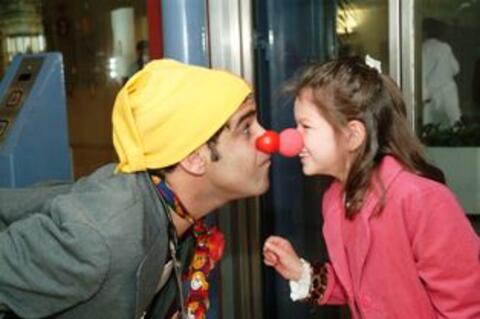
The Dream Doctors project integrates professional medical clowning into the medical services provided at Israeli hospitals. Established in 2002, Dream Doctors now operates at 16 hospitals throughout the country, with 70 Dream Doctors active in various paediatric wards and clinics. Dream Doctors draw on laughter to address the suffering of those in pain, particularly children. The Dream Doctors' vision is to transform clowning therapy into an officially recognised and firmly established paramedical profession, promoting academic research in this field and establishing a professional community.
Communication Strategies

The Dream Doctors are artists and actors with experience in theatre, clowning, pantomime, dance, and music. Through a year-long training program, they receive mentoring in issues involving the arts, medicine, and psychology. As expressive therapists and paraprofessional caregivers, the Dream Doctors use edutainment strategies to transform patients' and families' hospitalisation experience into something less traumatic and more pleasant. Dream Doctors' activity is designed to support and assist children's medical care, rehabilitation, and recovery processes through complete cooperation with the medical team.

To that end, Dream Doctors are integrated into the multidisciplinary medical staff of hospital wards. Reportedly, families, caretakers, medical staff, and administration cooperate fully with project. Through this symbiosis, an approach to patient care is developing at participating hospitals such that medical clowning is construed as an integral part of the treatment scheme. Each hospital deploys its set staff of Dream Doctors in wards and units according to its needs and priorities.

The Dream Doctors' work is documented daily on the project's website to promote cooperation, transparency, and professional knowledge. Hospitals make use of this information for review and evaluation purposes. Academic and clinical research on the Dream Doctors' work is encouraged so as to empirically evaluate benefits to patients. Also, organisers have created a BA programme in Clowning Therapy at Haifa University that is currently expanding into a Master of Arts (MA) programme.

Development Issues

Health, Children.

Partners

Funded by the Magi Foundation.

Sources
Teaser Image
http://www.comminit.com/files/DSCF0007fffffffffffffffffff.jpg