











































One Laptop per Child (OLPC)

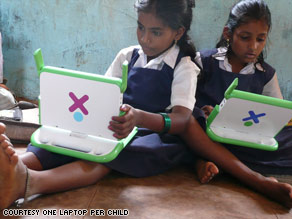
OLPC's "XO" laptop is approximately the size of a small textbook. Equipped with built-in free wireless internet connectivity and open-source programming, it is designed to be durable, functional, fun, and energy-efficient (also enabling the use of alternate power systems such as solar, human power, generators, wind, or water power). Its dual-mode display includes both a full-colour, transmissive mode, and a second display option that is black-and-white, reflective, and sunlight-readable at three times the resolution. Organisers claim that the XO-2, the second generation machine, features dual touchscreens, is smaller and lighter, and is more power efficient. For details of all the hardware and software components, click here.
OLPC has deployed laptops around the world. For a map of deployments, click here. To see a Wiki with current statistics, click here. When the laptops first rolled out in 2007, they cost US$205 each; as of March 2009, the cost had been reduced to US$180. The hope is that with corporate sponsorships and donations, collected through OLPC's Give One Get One programme and Give Many campaign, a broader community of participation can help ensure that the computers can be delivered to children at no cost to the economically poorest host country governments. (Media materials such as posters and videos with celebrity voices have been created to stimulate donations; click here to access these). Also, thousands of volunteers around the world offer technical support and training, and serve as translators and programmers.
The XO Laptop is designed to bring children technology as a means to freedom and empowerment through education. Learning is the main goal. "We do not focus on computer literacy, as that is a by-product of the fluency children will gain through use of the laptop for learning." Because the focus is on learning through doing, OLPC puts an emphasis on software tools for exploring and expressing, rather than instruction. "Using the laptop as the agency for engaging children in constructing knowledge based upon their personal interests and providing them tools for sharing and critiquing these constructions will lead them to become learners and teachers."
OLPC has launched various learning projects around the world, such as a learning centre founded at the Kigali Institute for Science, Technology and Management (KIST) in Kigali, Rwanda, in June 2009. In collaboration with the government of Rwanda, OLPC opened the "Global Center for Excellence in Laptops and Learning" to create examples of learning with connected laptops in schools and communities, support ongoing laptop implementation plans in Rwanda, and create an African regional laptop network. As part of the government's commitment to providing all 2.2 million of its primary school children with laptops by 2012 and to serving as a model for other countries, the Center also will develop senior fellows, community learning specialists, and technology specialists who will return to their countries to lead efforts nationally, regionally, and locally to extend laptop learning programmes. That is, the Center will strengthen the local team working on OLPC rollout in Rwanda, and further support it in terms of capacity development, technology acquisition and innovation, building networks of laptops, maintenance, and content development.
Capacity-building strategies also shape the 2-week orientation programme offered to university students participating in OLPCorps, a summer grant programme designed to get laptop pilot programmes up and running across the African continent. After completing their training, the students will form 30 teams to be deployed in 17 countries in sub-Saharan Africa for a 10-week period during which they will work directly with local community partners to integrate the XO laptop into primary education.
Education, Technology.
From the OLPC website: "A computer uniquely fosters learning by allowing children to 'think about thinking', in ways that are otherwise impossible. Using the XO as both their window on the world, as well as a highly programmable tool for exploring it, children in emerging nations will be opened to both illimitable knowledge and to their own creative and problem-solving potential. OLPC is not, at heart, a technology program, nor is the XO a product in any conventional sense of the word. OLPC is a non-profit organization providing a means to an end - an end that sees children in even the most remote regions of the globe being given the opportunity to tap into their own potential, to be exposed to a whole world of ideas, and to contribute to a more productive and saner world community."
David Cavallo, OLPC's Vice-President of Learning claims that the laptops' mere existence keeps kids coming to school. He spoke of a school in Rwanda that lacks electricity and traditionally had a 50% attendance rate. It is now drawing 1,000 more students than its previous full capacity, he said, and is even attracting kids - who in turn are teaching their parents and grandparents - on weekends. Matt Keller, OLPC's Director for Europe, Middle East, and Africa, recalled a visit to rural Ethiopia. As he passed out the laptops, he kept one eye on the children, the other on his watch. Seven seconds was all it took for an 8-year-old boy to flip open the never-seen-before computer, find and then hit the power button. Within 2 weeks, that boy and his classmates would be programming.
"Laptops Bring Lessons, Maybe Even Peace", by Jessica Ravitz, CNN, March 5 2009; and the OLPC website, accessed on August 6 2009.

- Log in to post comments