











































When a King Has Good Counsellors, His Reign is Peaceful: Video and Facilitator's Guide
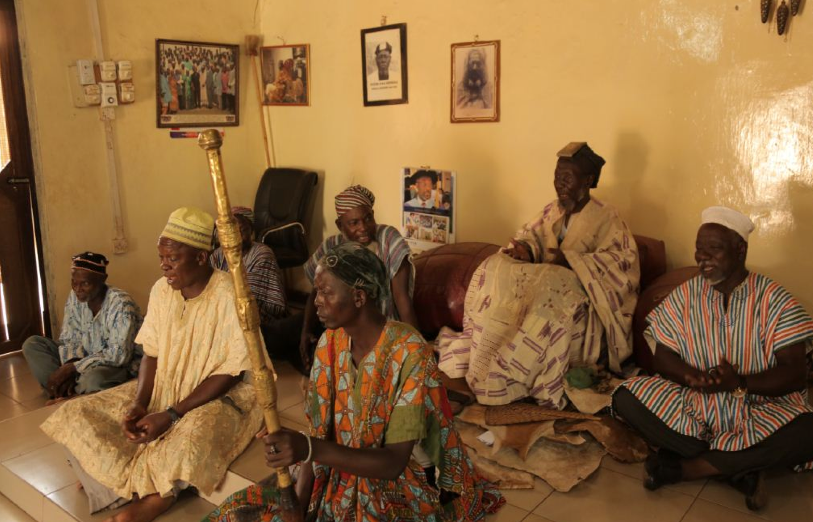
To draw leaders’ attention to the problem of stunting and their role in improving young children’s nutrition outcomes, the Strengthening Partnerships, Results, and Innovations in Nutrition Globally (SPRING) project in Ghana produced a 24-minute advocacy video and discussion guide. These tools are designed to be used by community advocates working with leaders to improve nutritional outcomes for children during their first 1,000 days. Although they were developed by SPRING for their project facilitators, the materials can be used by anyone who gathers an audience of influential community, traditional, religious, and/or government leaders committed to improving Ghana’s future.
As explained in the guide, “Undernutrition is a key cause of poor child growth and development, including early mental development. Early child growth, beginning during the mother’s pregnancy and continuing until the child is two years old, sets the stage for later life. Losses in physical and cognitive development resulting from undernutrition during this period, the first 1,000 days, cannot be recovered later on. Children who suffer from abnormally slow growth do not perform well in school and are at risk of becoming less productive as adults, which affects their lifetime earnings. Slow economic development in northern Ghana can be attributed in part to child undernutrition.”
The video explores the extent of the problem of stunting in northern Ghana, and describes what can be done by leaders and household heads to improve nutritional outcomes during a child’s first 1,000 days by offering ideas on how leaders can take specific actions: speak out, model positive behaviours, and influence policies and resource allocation around high-impact nutritional practices that will change the course of health, development, and economic success among households and communities. The video also features leaders in northern Ghana who are working to influence their communities (and particularly male heads of households) to take action. These actions include: visiting local health centres and observing growth monitoring activities to make sure that household members, including men, actively participate; encouraging fathers to use some of their money to purchase liver, fish, and eggs for young children over six months of age; and helping men and other family members build latrines and hand-washing stations.
The accompanying discussion guide is available for facilitators to use in leading a 3-4 hour discussion session that includes a viewing of the video. It is designed to spark conversation about child undernutrition among community leaders and to help them develop community action plans to enable households, especially male heads of households, to make changes. It includes guidance on organising a group discussion, additional information on the topic, and suggested questions and activities to spark discussions.
English
32 pages (Discussion Guide)
SPRING Project Newsletter [November 1 2017] and SPRING website on November 2 2017.
- Log in to post comments