










































What Kind of 'A Girls' Thing'? Frictions and Continuities in the Framing and Taming of the HPV Vaccine in Finland
University of Tampere
"[T]he online discussion of the HPV vaccination itself is an example of how socio-cultural structures are (re)built in the moment of individually faced uncertainty."
The cognitive and behavioural aspects of human papillomavirus (HPV) vaccination are attracting increasing attention among health scientists. In a Finnish context, this article researches the mediations between sites and rationales of HPV vaccination: the ones of vaccination officials responsible for the vaccination communication campaign and the intended recipients of that campaign - adolescent girls who make the decision to vaccinate or not - and traces both frictions and continuities between these "landscapes of meaning".
Author Mikko J. Virtanen uses the concepts of "framing" and "taming" to convey different aspects of meaning formation. She writes: "Framings are mundane and often unreflected upon processes, while tamings are cognitive, rationalised, and technicalised forms of framing. The vaccine is made meaningful by framing issues (vaccination) and taming specific complexities (the decision whether to undergo vaccination or not) into a less complex, familiar form." In this article, the processes of framing the complexities and actively taming them are analysed utilising a cultural-sociological framework.
The HPV vaccine has been included in the Finnish national vaccination programme (NVP) since 2013, and the first vaccinations were administered in November 2013. Girls aged 11-12 years (6th grade) are offered a free Cervarix vaccination as a 3-dose series through a school-based programme. HPV vaccination rates have remained relatively low in Finland so far; the overall cervical cancer incidence is relatively low in the country, as well.
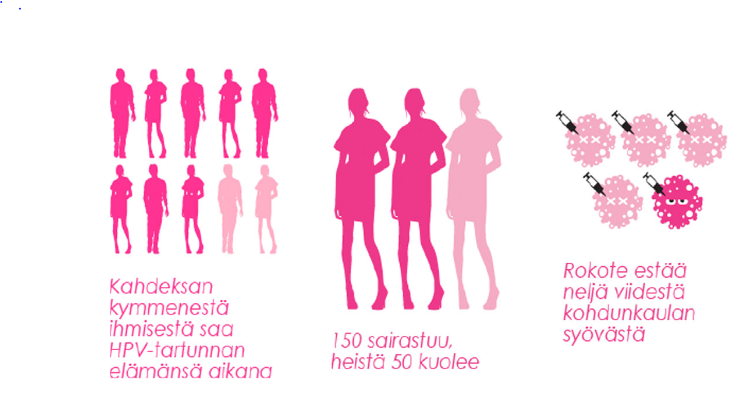
Firstly, the taming work of the epidemiologists is examined by focusing on the official Finnish HPV vaccination communication campaign, launched in 2013. Virtanen's data include the campaign's planning phase materials (12 printed pages of textual and visual content) made by the advertising agency Recommended (reco.fi), as well as the official campaign materials gathered from the campaign website (tyttojenjuttu.fi), consisting of textual information, pictures, and other visualisations and short information clips on YouTube. She conducts interpretative, thematic analysis of (i) the framings and tamings of HPV and cervical cancer, and (ii) the subject-shaping of the adolescent girls in the materials. The interpretation work is carried out two dimensionally, on the epistemic-factual and social dimensions.
The guiding outline for the communication campaign is formulated as tripartite in the planning materials: (i) daughters as the main group to be reached; (ii) goal: arouse interest, distribute information; (iii) tone: reliable, clear. Based on this outline, the campaign is tailored to a one-theme concept, "a girls' thing".
- Instead of the conventional top-down health communication, the concept is intended to produce a fresh, grassroots approach. The girl-centredness is manifested throughout the visual materials: the theme colours are pink and magenta; all the pictures contain teenage girls, mostly with friends; and all the banner texts and visualisations are pronouncedly clear and unambiguous.
- Except for the letters sent home and a couple of text boxes directed at parents on the campaign website, the campaign materials directly speak to adolescent girls. This contrasts with the "One Less" campaign in the United States (US), which depicts girls as empowered tamers of individual cancer risk and mothers as responsible for the health of their daughters.
- The campaign materials approach the vaccination-aged girls by using social imagery familiar to them; a socio-cultural exclusiveness is enacted by portraying adolescent girls having fun socially. On the other hand, the vaccination is ultimately offered to individuals. The issue itself - whether to be vaccinated or not - is a matter to be pondered individually and rationally, and sociality and solidarity gets framed outside this core epistemic-factual question.
Thus, as implied by the campaign, it is up to the girls themselves to frame and tame the question of whether to be vaccinated or not socially among peers - in online discussions, for instance. Accordingly, the second data corpus consists of vaccination-aged girls' online contributions to a discussion about the HPV vaccination on demi.fi, a Finnish internet site for girls aged 10-18 years. All the online discussions are moderated, and participation requires registration. The HPV vaccination was discussed in several threads from 2013 onwards, 4 of which were selected for this study. Selected findings:
- Especially in the comments with a positive attitude towards the vaccine, the HPV-cervical cancer link was taken for granted; the HPV vaccine was framed unambiguously as a cancer vaccine.
- Print and online media were mentioned relatively often in both critical and uncritical comments, and links to official statements and other texts were attached. However, references to alternative, vaccine-critical media were relatively rare and were followed without exception by comments questioning both the status of the source and the media literacy of the referrer.
- The vaccination was framed by references only to fellow females, and this gender frame remained untouched throughout the discussions.
- Mothers' opinions came up as crucial in the girls' own framings of the issue and tamings of the decision. Mothers were referred to as authorities, whether demanding or refusing the injection. Their opinions were also contrasted with the views of friends, and there was friction between the two in terms of peer pressure.
- The uncertainty of the decision was framed by positing it outside the scope of one's own reasoning, into the realm of the officials, who were framed as essentially trustworthy authorities.
- Pro-vaccination justifications were contrasted with the anti-vaccine stories in the (alternative) media. The media narratives were downplayed both by questioning the status of the medium in question and by the underlying trust in official, scientifically proven information. However, anecdotal stories, mostly about the sufferings caused by cancer, were not downplayed in a similar manner but framed as authentic and justified instead.
- When the issue was framed negatively in epistemic terms, the questioning of official expert knowledge was the most common theme. However, the criticism of official knowledge was not solely grounded on alternative knowledge but, rather, on a lack of sufficient knowledge, including among health officials.
- The underlying cancer frame was not really questioned. However, the cancer vaccine frame, the rationality of the new official preventive method - i.e., vaccination - was challenged: Regular Pap screenings were framed as a more effective cancer prevention method than the vaccine in the girls' "con" vaccination comments.
In conclusion: "When the vaccine is included in the NVP, it must be effectively delivered to the target group to reach the campaign goals. This is not only a matter of technical administration, however....The 'a girls' thing' campaign was created...to embed the vaccine in the social world and the landscape of meaning of vaccination-aged girls. In the campaign materials, targeted directly at the adolescent girls through girly socio-cultural imagery, the aetiological complexities have been tamed and the image is clear: the papillomavirus is common and causes cervical cancer; cervical cancer is deadly; and vaccination is the most effective defence against this insidious cancer. Consequently, a rational and responsible subject consciously taking care of her (reproductive) health by getting the shot is enacted. Yet, the rationality of this rationale was both confirmed and contested in the adolescent girls online discussions."
Sociology of Health & Illness. doi: 10.1111/1467-9566.12853.
- Log in to post comments