










































Red Hand Day
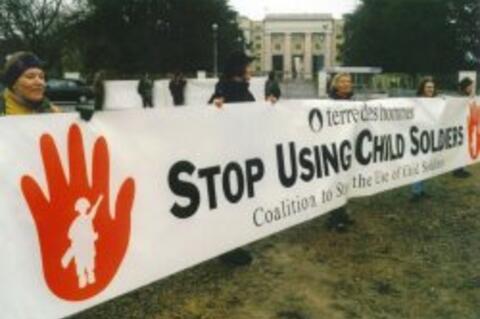
Red Hand Day is a worldwide grassroots initiative to demand stronger action by international leaders to end the use of child soldiers. Created by the Coalition to Stop the Use of Child Soldiers, the campaign culminates each year on February 12 - the anniversary of the day the international United Nations (UN) treaty prohibiting the forced recruitment or use of children under the age of 18 in armed conflict took effect. As part of this campaign, former child soldiers and other youth organise awareness-raising activities to create and gather symbolic "red hands" (made of paper). In 2009, there was a one-off effort (the "Red Hand Campaign") to collect one million red hands, made of paper, to be delivered to the UN Secretary-General on February 12 2009. Red Hand Day occurs every year on February 12 and is an opportunity for anyone, anywhere in the world, to organise an event to raise awareness about child soldiers. The youth activists are calling for:
- stronger UN action against governments and armed groups using child soldiers, including Security Council arms embargoes and other sanctions against persistent violators;
- prosecution of military leaders who recruit or use child soldiers;
- universal ratification and enforcement of the Optional Protocol to the Convention on the Rights of the Child on the involvement of children in armed conflict; and
- increased support for the rehabilitation and reintegration of former child soldiers.
Each year, young people take the lead in mobilising people of all ages to express their protest against the use of children in wars by making red handprints on paper and banners, inscribing personal messages calling for an end to the use of child soldiers. For instance, red hands created by former child soldiers in Guinea and Cote d'Ivoire included messages calling for rehabilitation and reintegration assistance for former child soldiers. To facilitate such projects, young campaigners (from 101 countries, during the 2009 campaign) organise hundreds of events, including marches, petition drives, special exhibitions, public awareness programmes at their schools, and other activities to highlight the continued use of child soldiers. Some deliver red hands to their members of congress or parliament. For example, in Germany, campaign participants delivered tens of thousands of red hands to German president Horst Köhler on February 12 2009, and in Belgium, activists presented "red hands" to the Belgian vice prime minister and minister of foreign affairs at a special event in Brussels.
A strong element of the campaign each year is the active participation of former child soldiers. For example, in 2009 in Goma, north Kivu (a province in the Democratic Republic of the Congo (DRC) affected by new recruitment of children in 2007/08 by government forces and armed groups), 11 child protection organisations and over 50 children (including many former child soldiers) and local authorities met to review the situation and listen to the testimony of a former child soldier. And local non-governmental organisations (NGOs) throughout eastern DRC hosted public rallies bringing together child rights advocates, children, local authorities, and traditional leaders to increase awareness of the illegality of child recruitment and use.
Academic institutions have played a role in integrating Red Hand actions into a broader learning context. For example, in one school in the state of Wisconsin (United States, or US), students learning to speak the Spanish language watched the movie "Voces Inocentes" ("Innocent Voices") about the recruitment of child soldiers in El Salvador's civil war. One student writes, "We decided we wanted to research more, so we did and ended up creating a wiki space (collaborative web page) in Spanish about the topic. While researching we discovered the red hand campaign and decided that we wanted to participate as a class. We then teamed up with the Spanish Honor Society and began working. We made presentations in the foreign language and cultural geography classes at the high school, a middle school class, a University Spanish class, and a local church group. We also made red hands one day in our school commons and at a basketball game. We collected 828 red hands." At another US high school, students installed a photo exhibit of child soldiers and invited their peers to view the installation. The students made 531 red hands and signed large red hands to send to the office of their congressional representative.
Each year, participants are urged to share the stories of their Red Hand Day activism. Organisers encourage campaigners to "Take Photos! Write a Letter to the Editor! Hold an event! Post a video on YouTube! Be Creative!" Details about specific youth initiatives are shared - via photos and narrative - on the Red Hand Day website. The mass media are also spreading the word; for instance, in India, where 35,000 red hands were collected in 2009 from across the country, activists held a press conference in Pune, near Mumbai.
Children, Rights, Conflict.
The Optional Protocol to the Convention on the Rights of the Child on the involvement of children in armed conflict has been ratified by 126 countries and entered into force on February 12 2002. It prohibits the direct participation of children under age 18 in hostilities, and sets 18 as the minimum age for recruitment by armed groups and for compulsory recruitment by governments. But child soldiers are still being used in at least 15 countries or territories, including some that have ratified the treaty: Afghanistan, Burma (Myanmar), Central African Republic, Chad, Colombia, Democratic Republic of Congo (DRC), India, Iraq, Occupied Palestinian Territories, Philippines, Somalia, Sri Lanka, Sudan, Thailand, and Uganda.
According to organisers, "child soldiers suffer a great deal when in the ranks of an armed force. Conditions are usually harsh and discipline maintained by brutal punishment. Life is dangerous and characterized by hard work, lack of food, drinking water and sanitation, no access to health services and constant fears of being trapped in an ambush, landmines or gunfire....Approximately one third are girls. They carry out the same tasks as boys but are frequently subjected to sexual violence and forced to...serve as sexual slaves. As a consequence they are often infected with HIV/AIDS or other sexually transmitted diseases. Many become pregnant. In some cases they are stigmatized and have to live with their babies under war conditions. The story is not over once these young people return home. Some discover their families have been killed or their homes destroyed. There may be little chance of finding a job or returning to school and some turn to crime or prostitution. Many must deal with physical disabilities. Communities may find it difficult to accept these former soldiers, and the youth themselves may reject community rules or traditions."
Editor's note: All correspondence about Red Hand Day should go through the contacts listed on the Red Hand Day website; red hands may be collected as part of Red Hand Day events each year, but they should not be sent to the Coalition.
Human Rights Watch (HRW) website; Red Hand Day website; and email from Andrew Lowton to The Communication Initiative on February 18 2009. Photo credit: Copyright Terre des Hommes.
Comments

Red Hand Day
M.B. Usman
very useful.
- Log in to post comments