

























Child rights action with informed and engaged societies

After nearly 28 years, The Communication Initiative (The CI) Global is entering a new chapter. 

Following a period of transition, the global website has been transferred to the University of the Witwatersrand (Wits) in South Africa, where it will be administered by the Social and Behaviour Change Communication Division. Wits' commitment to social change and justice makes it a trusted steward for The CI's legacy and future. 

On the transfer, co-founder Victoria Martin expressed her pleasure to see this work continue under Wits' leadership, knowing that co-founder Warren Feek (1953–2024) would have felt deep pride in The CI Global's Africa-led direction. 

As Wits, we honour the team and partners who sustained The CI for decades and look forward building from that strong base. This includes co-founders Warren Feek (1953-2024) and Victoria Martin as well as La Iniciativa de Comunicación (CILA), which continues independently at lainiciativadecomunicacion.com with links to The CI Global site. We are also eager to forge new partnerships and entertain new ideas as we consider how best to contribute to social and behaviour change in our rapidly evolving environment.

If you are joining the International Social and Behaviour Change Communication (SBCC) Summit in Panama, please join Wits and CILA on Monday, 22 June, to share your thoughts and suggestion for the relaunch of the Communication Initiative. We will be in Pacifica 5 from 12-1:25 for the Refuel, Reflect, and Renew Lunch Series: The Communication Initiative: celebrating a driving force for Communication for Social Change and the way forward. We will reflect on the legacy of Warren Feek and family in creating the Communication Initiative, consider the contributions of CI over the years and then turn our attention towards the future in this dynamic session. 

If you are unable to join us in Panama, we still want to hear from you. Please contribute your thoughts by following this link: https://redcap.link/CommunicationInitiative2026 or reaching out to ci_surveys@commint.com

You can also follow the QR Code:

 https://redcap.link/CommunicationInitiative2026

Time to read
1 minute
Read so far

Pre-teen Vaccine Campaign

0 comments
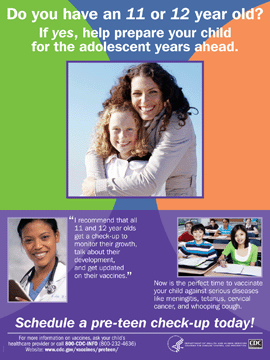
In August 2007, the Centers for Disease Control and Prevention (CDC)'s National Center for Immunization and Respiratory Diseases launched a vaccination campaign geared toward parents and caregivers of pre-teens of various ethnic groups in the United States (US). Campaign materials, including flyers, posters, and web buttons, were created to educate parents about the recommended check-up for adolescents ages 11-12 years, and encourage them to make an appointment for their pre-teen.
Communication Strategies

This initiative uses information and communication technology and mass media to share materials designed to raise awareness that immunisation is not just important for babies, and to spur action so that disparities in access to this preventive health service are reduced. The 4 pre-teen vaccines include: i) the flu vaccine; ii) MCV4, which protects against meningitis and its complications; iii) Tdap, which is a booster against tetanus, diphtheria, and pertussis or "whooping cough"; iv) and for girls, the HPV vaccine, which protects against the types of human papillomavirus (HPV) that most commonly cause cervical cancer.


The campaign website provides downloadable educational materials - fact sheets and posters - in English and Spanish for parents and health care providers about preteen vaccines and the preteen check-up. A pre-teen vaccine e-card (in English) is also available. Materials designed specifically for African American, Caucasian, Hispanic, and Native American populations are offered, with materials for Asian American parents in Vietnamese and Korean in the process of being prepared (as of September 2009).


The campaign also includes outreach to mainstream and ethnic media, as well as the creation of partnerships with national and state organisations that reach parents, and healthcare providers. Specifically, in August 2008, the CDC announced that new public service announcements (PSAs) intended to reach the parents of pre-teens had been created and were being made available to broadcast organisations. The television and radio spots urge the parents of 11- and 12-year-olds to vaccinate their kids. Available in both English and Spanish and at lengths of 60, 30, and 15 seconds, the PSAs are available for download and broadcast here.

Development Issues

Immunisation and Vaccines.

Key Points

"Many parents do not realize that some childhood vaccines, such as those for tetanus and whooping cough, wear off over time and, as they get older, young people are at risk of exposure to different diseases at school, camp or in other new situations," said Dr. Anne Schuchat, Director of CDC's National Center for Immunization and Respiratory Diseases.

The recommended 11- or 12-year-old check-up is endorsed by the American Academy for Pediatrics, and the American Academy of Family Physicians in addition to CDC. "The preteen check-up is a great time to talk with your child's healthcare provider about your child's development, nutrition, safety, and vaccination status," said Dr. Schuchat.

Sources

Immunization Action Coalition (IAC) Express #820, August 31 2009; campaign website, September 1 2009; and emails from Aparna Ramakrishnan to The Communication Initiative on September 2 2009.
Teaser Image
http://www.comminit.com/files/p_hpvfacts_sp_view.jpg