

























Child rights action with informed and engaged societies

After nearly 28 years, The Communication Initiative (The CI) Global is entering a new chapter. 

Following a period of transition, the global website has been transferred to the University of the Witwatersrand (Wits) in South Africa, where it will be administered by the Social and Behaviour Change Communication Division. Wits' commitment to social change and justice makes it a trusted steward for The CI's legacy and future. 

On the transfer, co-founder Victoria Martin expressed her pleasure to see this work continue under Wits' leadership, knowing that co-founder Warren Feek (1953–2024) would have felt deep pride in The CI Global's Africa-led direction. 

As Wits, we honour the team and partners who sustained The CI for decades and look forward building from that strong base. This includes co-founders Warren Feek (1953-2024) and Victoria Martin as well as La Iniciativa de Comunicación (CILA), which continues independently at lainiciativadecomunicacion.com with links to The CI Global site. We are also eager to forge new partnerships and entertain new ideas as we consider how best to contribute to social and behaviour change in our rapidly evolving environment.

If you are joining the International Social and Behaviour Change Communication (SBCC) Summit in Panama, please join Wits and CILA on Monday, 22 June, to share your thoughts and suggestion for the relaunch of the Communication Initiative. We will be in Pacifica 5 from 12-1:25 for the Refuel, Reflect, and Renew Lunch Series: The Communication Initiative: celebrating a driving force for Communication for Social Change and the way forward. We will reflect on the legacy of Warren Feek and family in creating the Communication Initiative, consider the contributions of CI over the years and then turn our attention towards the future in this dynamic session. 

If you are unable to join us in Panama, we still want to hear from you. Please contribute your thoughts by following this link: https://redcap.link/CommunicationInitiative2026 or reaching out to ci_surveys@commint.com

You can also follow the QR Code:

 https://redcap.link/CommunicationInitiative2026

Time to read
1 minute
Read so far

Macallinka Raddiyaha (The Radio Teacher)
1 comment
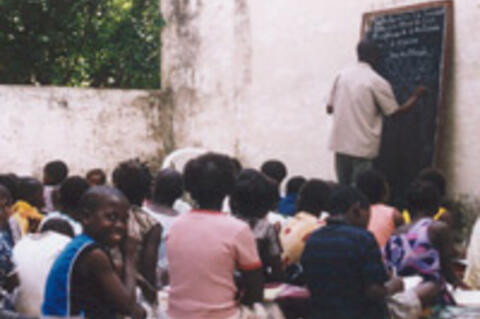
Launched in 2002 by the BBC World Service Trust and the Africa Educational Trust (AET), this education project aims to teach rural Somalian men and women to read and write through radio programming and training.
Communication Strategies

The programme includes three teaching elements: a half-hour weekly radio programme broadcast by BBC World Service, print materials, and face-to-face teaching. The radio programmes use materials almost entirely from Somalia that look at human rights issues, ways of sustaining the environment, and strategies people can use to stay healthy. Literacy teaching is based on key words that emerge from the radio programmes. The radio programmes are heard all over Somalia and in neighbouring countries, including Ethiopia, Djibouti, Kenya and Yemen. (This means that the programme may reach even those populations that are displaced by violence, as long as the teacher and class can keep together as they move).

The programme is designed to encourage community initiative and involvement. If a community decides that it wants to take part, it will nominate a teacher, who will receive brief training, a teacher's print pack, and a set of students' packs. How classes are organised and where they take place is entirely up to the community, depending on what resources are available.

Development Issues

Education.

Key Points

The programme hopes to help 12,000 men and women to learn to read and write within a one-year period. These men and women are veterans of the violence that has afflicted Somalia since the early 1990s. The United Nations Children's Fund (UNICEF) estimates that only 170,000 children received schooling in 1989. Even today, according to European Union and United Nations' agency estimates, only 20% of all children (and 5% of girls) go to school.

Early radio trials resulted in requests for 6,600 student packs.

The BBC Somali Service has been broadcasting since 1957; approximately 85% of the population listens.

Partners

BBC World Service Trust, AET.

Comments

User Image
Submitted by Anonymous (not verified) on Tue, 11/30/1999 - 00:00 Permalink

possible but not happen it seems to me some thing that is relates for propaganda still somalian nations need educational development and your onformation is the idol far that should appear international court and additionally is the one of the criminal for the future.
thanks

Teaser Image
http://www.comminit.com/files/080220som_literacy_class_200.jpg