











































Lara

Much of Lara's work is motivated by the conviction that women's organisations, in general, have been consistently marginalised by international organisations implementing democratisation projects. Lara provides the following example of women's exclusion: In 2005, the Office of the High Representative (OHR) - having the responsibility and mandate to oversee the civilian aspects of the peace agreement - and government bodies agreed on the creation of a unified police force. However, women were excluded from this decision-making process despite what Lara characterises as their extensive experience and knowledge of the problems that people face in urban and rural areas. Lara contends that this kind of marginalisation subverts the empowerment of women and encourages the development of discriminatory structures, as it sends a signal that the voices and knowledge of women are not important.
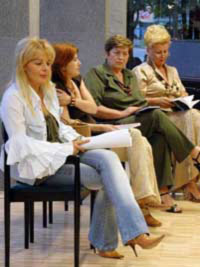
To help ensure that the voices of women are included in issues that affected them, the organisation has, since 2001, arranged weekly meetings called Coffee with the Mayor. Municipal representatives are invited, and come to the women's centre to answer questions from women and hear their concerns. A crucial component is that the meetings take place on Wednesday evenings - a time when men are usually involved in sport. The meetings provide the opportunity for women to speak directly to the politicians or their representatives. Lara contends that the meetings have contributed to accountability on the part of politicians. Reportedly, local politicians have realised that the coffee meetings can be of benefit to them, as they provide a forum for both women and politicians to put issues on the agenda. As a result, politicians themselves ask to attend and meet with the women.
Several campaigns and protests have emanated from these meetings. For example, in 2001 Lara engaged in advocacy in an effort to prevent trafficking of women and children in the area. The local authorities who were guests at a Coffee with the Mayor meeting and who were provided with evidence of trafficking from the 12 Bijeljina nightclubs pledged to support the campaign. After a period of four months, and with the support of local authorities, all of the nightclubs were closed and the municipality withdrew its approval for the opening of new nightclubs. A second campaign in 2007 concerned the cost of kindergartens. Following lobbying for equal opportunity for all children to attend kindergarten, the local municipality changed its budgetary decisions and now financially supports all kindergartens in the area.
Also, Lara conducts door-to-door projects in villages around Bijeljina to ask women about their life situation and their problems. They also come into contact with all kinds of women through their different activities and outreach work: refugees, the internally displaced, returnees, domiciles, etc. By showing the women in their area that they are genuinely interested in their situation, Lara seeks to gain the trust of the women and receive information that is often hard to obtain, such as information on corruption, security issues, and violence against women within the family. They follow these interactions up with designing projects and informing the local politicians. In light of the fact that international donors and NGOs need to ensure the involvement of people in the design and delivery of services, Lara feels that its proximity to and relationship with local circumstances and needs render its voice worth listening to.
Lara has created a website that it describes as "the first women portal" in Bosnia and Herzegovina. It features gender-related news, events, research, resources, interviews, etc.
Since 2000, Lara has been assisting victims of trafficking. In April 2003, Lara opened its own shelter for victims of trafficking. Ten girls may reside there at a time. In this safe place, creative workshops are held, a neuropsychiatrist and gynecologist provide health services, and legal and psychosocial assistance are offered. Lara uses its extensive network of women in the town and country to carry out its strategy of recovering victims quickly and turning them from victims into witnesses. Lara has also organised an anti-trafficking working group consisting of representatives of all the organisations that have offices in Bijeljina and Tuzla and work on trafficking issues, such as the Office of the United Nations (UN) High Commissioner for Refugees (UNHCR) and border-police. The group meets monthly in Lara's office to exchange information and coordinate activities such as training for police and a public awareness campaign.
To prevent trafficking in the first place, Lara has conducted research on the exploitation of children. "Protect yourself" is an educational campaign implemented by Lara in partnership with United Women Banja Luka. Lara has also organised 16 educational workshops in 8 primary schools with pupils, parents, and teachers. A group of peers was then consolidated and capacitated to hold its own educational workshops in schools about the issue of trafficking.
In order to raise public awareness of the issue, from 2003 to 2005 Lara organised a series of radio shows under the title "Anti Trafficking Radio Bridge" in the following towns: Bijeljina, Zvornik, Tuzla, Brcko, Orašje, and Doboj. And, as part of the 2005 campaign "Trafficking in Human Beings - Crime in the Neighborhood" (2005), Lara organised radio shows and public tribunals in the following towns: Travnik, Bijeljina, Prijedor, Banjaluka, Doboj, Tuzla.
Lara has also held several conferences on trafficking, all of which featured participation of representatives of national-level institutions, as well as representatives of NGOs and the media.
Women, Gender, Rights.
"Case Study 3: Trust, Marginalisation and 'Coffee with the Mayor' (Bosnia and Herzegovina)" in Participation and the Right to the Highest Attainable Standard of Health [PDF], by Dr. Helen Potts; and Peacebuilding Portal.
- Log in to post comments