










































InterACT!
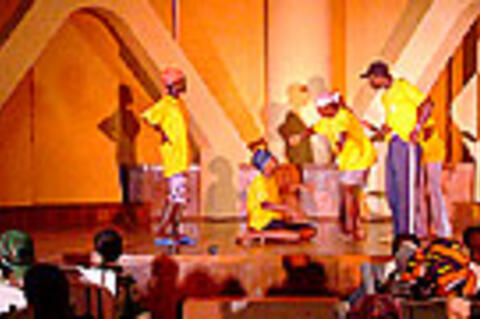
InterACT! uses Interactive Theatre to investigate issues central to HIV/AIDS and young people's rights through workshops and performances. Participants examine sexual relationships and practice and in the process bring about change in the patterns of male and female behaviour that can cause HIV infection and AIDS. The InterACT! programme is designed primarily for children, young people, and teachers who are trained as facilitators. This strategy is designed to ensure that a physical approach to reducing vulnerability to HIV is reaching large numbers of young people.
During the InterACT! workshops participants:
- learn the facts about sexual and reproductive health;
- investigate the reality of their experience of gender, relationships, and sexuality;
- explore how behavioural patterns are manifested through voice, movement and space;
- develop communication skills to enable them to change their behaviour and negotiate their relationships positively and safely; and
- practise these skills in action, in challenging situations in the safe arena of the workshop.
According to the organisers, the performances are:
- devised by workshop participants entirely from their experiences related to gender, sexual health, and HIV/AIDS, and performed in community venues;
- highly participatory, with audiences directly involved by being invited into the acting area to try to find practical strategies for changing the behaviour of the characters; and
- forums for developing dialogue with interest groups such as parents about gender and sex education and for the advocacy of children’s rights.
In the first phase of the programme, which began in May 2003, the organisers engaged in the following activities:
- formed the InterACT! network of 13 partner non-governmental organisations (NGOs) and the Accra Teacher Training College;
- trained 85 non-governmental organisation (NGO) staff and teacher trainees in the use of interactive theatre as a tool for changing behaviour around HIV/AIDS;
- established 35 focus groups of young people, each consisting of 15 young people and led by two trainees from each organisation;
- built the capacity of the InterACT! stakeholders' organisations to use interactive theatre
- developed information, education and communication (IEC) materials including a video, a manual, and a website;
- held a 4-day festival of interactive theatre in May 2004 at the National Theatre, Accra, which was attended by 3500 people; and
- performed in schools and community venues to over 9000 people.
The second phase of the programme will last for five years (2006 - 2011) and aims to increase the geographical scope of the project within Southern African enabling InterACT to work in five countries worst affected by HIV. In each country, the organisation will:
- train 3000 trainee teachers;
- establish partnerships with governments and local NGOs;
- establish 60 focus groups of in-school and out-of-school youth; and
- reach at least 17,500 young people through focus group workshops and performances.
In order to achieve their goals, the organisation proposes to follow 6 key steps that include a situational analysis, locating funds, conducting training, implementing interactive theatre workshops with young people in focus groups, promoting young people's rights, and capacity building.
To ensure sustainability at school, community and regional levels, the organisation says it will work closely with District Education Offices, teacher training colleges, head teachers, and partner NGOs. Currently, they have begun to develop partnerships with organisations in Malawi and South Africa who want to use Interactive Theatre as a methodology for other children's rights initiatives.
HIV/AIDS, Rights, Youth, Gender.
According to the organisers, "behaviour which may have seemed fixed becomes open to the possibility of being transformed. In this way, Interactive Theatre is a rehearsal for changing behaviour in life, and contributes to participatory health and sex education, awareness raising, stigma reduction, self-advocacy by young people and bottom-up policy making."
Organisers say that over 12,000 young people in the economically poorest areas of Ghana have been involved in workshops and performances and many report significant changes in their understanding of the disease, the rights of people living with HIV/AIDS (PWLHAs), and gender and sexual behaviour, including negotiating condom use and voluntary counselling and testing (VCT).
Catholic Action for Street Children (CAS), Centre for Community Study, Action and Development (CENCOSAD), Centre for the Development and Intercultural Communications (CEDIC), Centre for the Development of People (CEDEP), Centre for Popular Education and Human Rights Ghana (CEPHRG), Planned Parenthood Association Ghana (PPAG), Muslim Relief Association Ghana (MURAG), National Theatre, Pro-Link, West African Aids Foundation (WAAF), Wisdom Association, Young People's Experience for Change (YPEC), Youth Solace, Accra Training College (ATRACO).
Theatre for Change website on November 11 2004 and an email received from Patrick Young on May 12 2006.
- Log in to post comments