










































Home-Based Record Prevalence among Children Aged 12-23 Months from 180 Demographic and Health Surveys
United Nations Children's Fund (Brown); World Health Organization (Marta Gacic-Dobo)
"...[D]espite improvements in the availability, utilization and retention of home-based records for recording vaccination history in some countries, opportunities remain to change the mind-set in many national immunization programmes around the importance of the home-based record, particularly in countries with large birth cohorts."
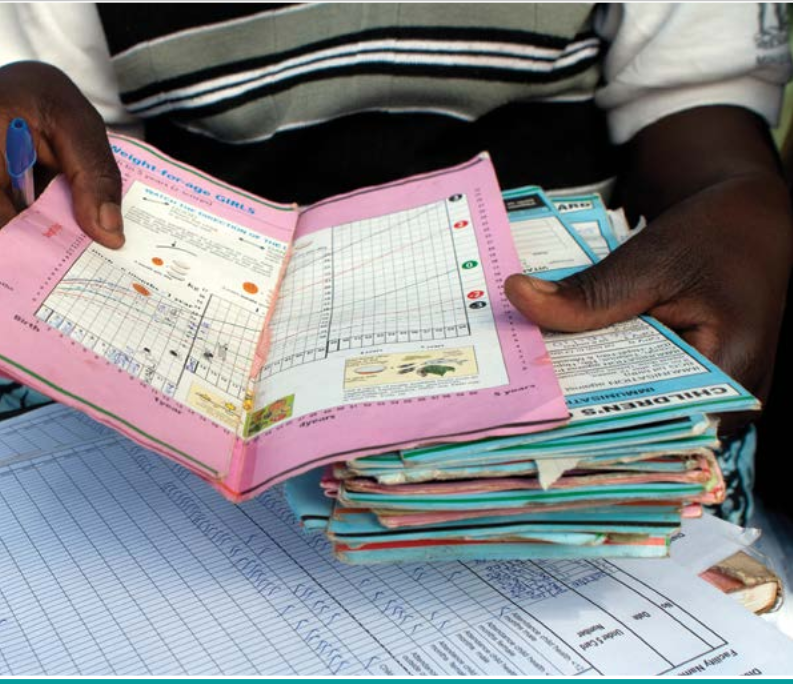
This report shares the results of an evaluation of the strategy of using home-based records, which is described here as "an important information resource to enhance health professionals' ability to make clinical decisions and prevent unnecessary repetition of vaccination, to empower patients/caregivers around immunization services, and to support public health monitoring." As stated here, these reports can support outreach activities to vaccinate un-/under-immunised children and serve as a source of documented vaccination history in household coverage surveys.
It presents estimated country-specific ever (the proportion of children aged 12-23 months who have ever received a home-based record) and current (the proportion of children aged 12-23 months for whom a home-based record was available for viewing by the surveyor at the time of the survey) home-based record prevalence from nationally representative household surveys to examine the utility of vaccination records maintained in the household (as opposed to the health care facility).
The researchers considered all Demographic and Health Surveys (DHS) - starting with DHS round 3 - conducted between 1993 and 2013 for which a final dataset was available in the public domain at the time of the analysis. They estimated ever and current prevalence of home-based records for recording vaccination for children aged 12-23 months at the time of the survey through a secondary analysis of data from 180 DHS conducted in 67 countries derived from questions asked of women aged 15-49 years for their children on home-based record availability and retention. They found that:
- Estimated ever home-based record prevalence was =90% in 116 surveys from 52 countries and was <70% in 15 surveys from 7 countries. Estimated current home-based record prevalence was =80% in 31 surveys from 23 countries and was <50% in 51 surveys from 24 countries.
- Current home-based record prevalence was <80% as of the most recent survey during 2010-2013 for five (Bangladesh, Ethiopia, Nigeria, Indonesia, and Pakistan) of the 10 countries with the largest birth cohorts globally.
- Among 34 countries that conducted 3 or more DHS, the researchers observed improvements in both ever and current home-based record prevalence of >10% points in 6 countries.
- Current home-based record prevalence increased >10% points in 6 countries where the ever prevalence was maintained at =90% across the period of observation.
- No meaningful change was observed in estimated ever and current home-based record prevalence in 11 countries, 5 of which maintained ever prevalence =90% across the period of observation. High home-based record loss rates were observed in many countries.
The study observed that, in 5 (Nigeria, Indonesia, Pakistan, Bangladesh, and Ethiopia) of the 10 countries with the largest annual birth cohorts, if current home-based record ownership levels from the most recent nationally representative population surveys accurately reflect the situation, these countries lacked appropriate vaccination history documentation for a collective total of 14.1 million children born in 2013, which is equal to 10% of all births worldwide.
Amongst the countries that are making progress, according to the research: Burkina Faso, Bolivia, Ghana, Mozambique, Cambodia, and Haiti. "Further work is needed to document the progress made in these countries and others, such as Colombia and Tanzania where high ever prevalence levels have been sustained while also improving retention levels, and to understand the factors and environments that bolster advancements so that they can be replicated elsewhere." These may include: changes to the home-based record content and/or design; use of hybrid synthetic papers that will accept ink and pencil while remaining durable in harsh environments, both inside and outside the household, and that resist moisture, fire, pests, bacteria, and tearing; interventions to incentivise retention of the home-based record; and/or bundling with supply chain management of vaccines and other commodities in vaccines service delivery.
The researchers conclude by encouraging immunisation programmes to monitor ever and current home-based record prevalence. "Nationally representative household surveys collecting information on immunization coverage should include ever and current home-based record prevalence in the standard survey reports and tables to better enable programme managers to identify problems and target corrective action."
Vaccine, Volume 33, Issue 22, 21 May 2015, Pages 2584-2593, sent via email from David Brown to The Communication Initiative on July 8 2015; and email from David Brown to The Communication Initiative on July 13 2015. Copyright © 2015 Published by Elsevier Ltd. Image credit: ©UNICEF/Christine Nesbitt
- Log in to post comments