










































Fostering Gender Equity among Early Adolescents: Benefits of Adding Family and Community Interventions to the Choices Curriculum
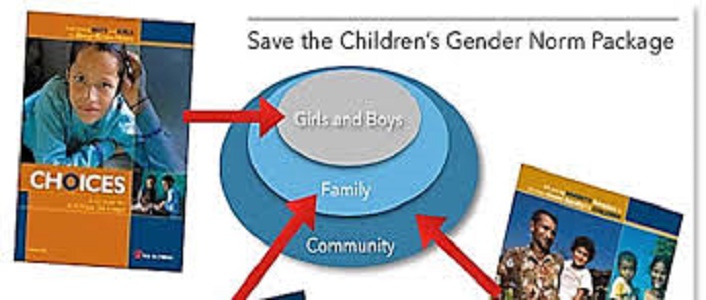
Save the Children and Institute for Reproductive Health at Georgetown University
"Over the period of 2009 to 2015, Save the Children and tested a package of gender transformative interventions for children, their parents and community."
Prepared by the Institute for Reproductive Health at Georgetown University, this report describes an evaluation of the Very Young Adolescents Gender Norms Package, working on gender norms and [promoting gender equality, through three components geared for the individual (Choices), family (Voices), and community (Promises) levels of Nepali society. This research aimed to determine the benefits of layering the three among 36 child clubs in the Terai Region of Nepal.
With several villages assigned to the control group, the experimental villages were delivered the parent and community components, while all of the villages received the Choices component. Baseline data was collected in 2015 and endline data a year later in 2016. "A total of 900 participants in each arm (300 girls, 300 boys, and 300 parents) completed structured interviews at baseline and end line. Qualitative data was also collected to provide insights into participation in Choices, Voices, and Promises and to explore the effect of rolling out the three components simultaneously. A total of five focus group discussions, each with six to eight participants, were conducted with parents in control and experimental areas. In addition, in-depth interviews were held with 15 girls in the control group VDCs [Village Development Committee] and 14 with girls in the experimental VDCs."
Interview methodologies devised to reduce courtesy bias include:
- Photo elicitation and vignettes used to keep parents engaged, avoiding direct questions
- a family of small dolls used with girls, encouraging acting out situations set out by the interviewer.
"The study team developed and tested parent and VYA [Very Young Adolescent] measures of gender norms, attitudes, and behaviors in five domains: gender equitable education, household chores, delayed marriage, gender equity in aspirations, and supportive and loving relationships."
The intervention began with a three-day orientation of staff on concepts related to gender, poverty, and inequality. Clubs selected a boy and a girl facilitator from each of 36 clubs who were then given facilitation training in a five-day training on Choices content. non-governmental organisation (NGO) community mobilizers, project officers, and programme coordinators were trained to implement Voices. "Lastly, Save the Children conducted a two day training for four NGO community mobilizers on Promises implementation." Despite a 2015 earthquake and 2016 political strikes and curfews, "between half and 70% of the child club participants attended five or more of the nine Choices sessions....Voices was implemented [simultaneously] in each of the 18 wards in the two experimental VDCs. Voices consists of six videos each lasting about ten minutes....Two weeks after Choices began, the first of six Promises posters was installed on the strategically placed community message boards. Extension workers invited pre-selected influential community members to the poster unveiling and conducted a group dialogue. For the next eight weeks, the subsequent poster was installed accompanied by a group discussion approximately every ten days. Community influencers were encouraged to talk about the posters with their friends and family and motivate them to go look at the poster."
In the experimental arm, 70% of parents and 60% of fathers were reached. Two of the parent measures considered to be of moderate quality, both on delaying marriage of girls, did not show a positive effect in the addition of Choices/Promises. However, moderate/highquality measures in the assessment of the VYA age group showed improvement from baseline to endline, concentrated in the gender equitable education and gender equitable household chores and resource sharing domains, with less evidence of intervention effect in the domains for delaying marriage for girls and gender equity in aspirations.
Reasons for reduced effects of the programme may be that the compressed time frame due to natural disaster and civil unrest resulted in less time for reflection and trialing of behaviour change. Among VYA, moderate or high quality measures differed significantly by gender, but not in a consistent direction, underscoring "the theory that girls and boys experience different gender socialization processes, and may be socialized differently in various gender and behavioral domains," though there was not substantial variation between 10-12 year-olds and 13-15 year-olds.
The study concludes that more research is needed on VYA gender equality efforts and "suggest[s] that including a parent component to a VYA gender transformative intervention may increase VYA’s reports of gender equity in education and household domains." It suggests further work on carefully tailored interventions to address normative factors related to girls' education and early marriage combining gender norms packages for VYA with adult and community interventions.
Save the Children website, August 20 2018.
- Log in to post comments