










































Engaging Government Health Staff to Promote Nutrition at the Community Level
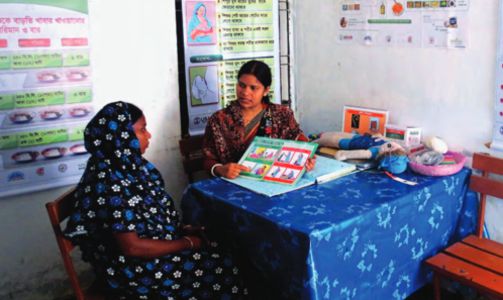
Funded by the United States Agency for International Development (USAID), Strengthening Partnerships, Results, and Innovations in Nutrition Globally (SPRING)/Bangladesh aims to decrease undernutrition among women and children by focusing on the 1,000-day window of opportunity (between pregnancy and 2 years of age). SPRING in Bangladesh partners with government health and agriculture staff to reach pregnant and lactating women (PLW) and children under 2 through numerous contact points in a variety of settings and through a range of interventions over a sustained period of time. The comprehensive, behaviour-centered approach to social and behaviour change communication (SBCC) comprises 3 strategic elements: coordination, capacity development, and community engagement. One major component of the project is to support the Government of Bangladesh (GOB)'s Ministry of Health and Family Welfare (MOHFW) by providing training and supportive supervision to frontline health workers to ensure that quality nutrition services and messages are being delivered to members of rural communities. This brief describes and evaluates this process.
Working in the Barisal and Khulna divisions of the USAID Feed the Future zone of influence, in 9 districts and 40 upazilas (subdistricts) covering 373 unions and approximately 125,000 pregnant and lactating women, SPRING has adopted the essential nutrition and hygiene actions (ENA/EHA) framework for its multi-sectoral programmatic approach. This framework outlines a set of evidence-based interventions to improve SBCC for nutrition practices during the critical 1,000 days. SPRING's SBCC framework promotes the adoption of ENA/EHA by individuals, households, groups, and communities. SPRING/Bangladesh conducts 4-day master training sessions in ENA/EHA with supervisory-level health and family planning workers from the MOHFW, who in turn lead cascade trainings for frontline health and family planning workers. Trainers use two sets of training materials: 1) the ENA/EHA for health workers curriculum builds communication skills; and 2) since its approval in 2014, the GOB's Basic Nutrition Training curriculum has been designed to help frontline health workers gain a deeper technical understanding of the key concepts in nutrition for pregnant and lactating women and mothers with young children.
Specific elements of the framework include:
- Coordination - Coordination informs and motivates leadership at upazila and union levels to create supportive health campaigns. Community nurturing furthers MOHFW goals by creating a sensitised community that understands the importance of nutrition and the risks of not following these simple actions carefully.
- Capacity Development - SPRING has often found this to be most effective through face-to-face dialogue with individuals or groups to inform, motivate, problem-solve, or plan, with the objective of promoting and sustaining behaviour change. SPRING develops the capacity of government staff in two major ways: training and supportive supervision.
- Community Engagement - SPRING supports community health facilities, agriculture extension workers, existing community groups, and the 9-month Farmer Nutrition School (FNS), which serves as a forum to improve the production and consumption of diverse nutritious foods at home alongside the adoption of the ENA/EHA. Working with the MOHFW, SPRING supports community clinics by helping with health campaigns and involving them in SPRING's FNS work at the village level. This support to the MOHFW is meant to build a stronger relationship with the community and encourage it to make better use of frontline health services. SPRING/Bangladesh's efforts to link its FNS graduates with community clinics and their support groups are designed to strengthen the ties between the community clinics and the communities they serve, thus strengthening the MOHFW's reach and influence.
The brief outlines the step-by-step implementation of this process. Advice offered here includes:
- Secure buy-in - SPRING focuses on ensuring that support for improvement in nutrition is given through the government and by the government.
- Provide SBCC support and leverage existing resources - For example, SPRING participates in the national Behavior Change Communication (BCC) Working Group and was a member of the technical committee that reviewed and finalised the national BCC framework for improved nutrition in Bangladesh during 2014. SPRING/Bangladesh makes use of materials already available and, rather than creating new materials, has focused on using only those endorsed by the government.
- Conduct practical training on ENA/EHA at all levels - Trainings complement ongoing government initiatives, such as exclusive breastfeeding campaigns, vitamin A campaigns, FNS nutrition fairs, and other community events. ENA/EHA message delivery coupled with government-sponsored activities helps ensure that communities stay mobilised around nutrition.
- Offer supportive supervision - Described in detail here is a process of guiding, helping, and encouraging staff members at their place of work to improve their knowledge, skills, and performance and thus meet defined performance standards.
- Invest in community nutrition champions and community mobilisation - At the end of the 9-month-long FNS curriculum, each FNS group selects a community nutrition champion (CNC) to promote the learned practices in the community and to serve as an advocate for nutrition in that community. The post is voluntary and not remunerated. CNCs become coopted members of community support groups affiliated with government community clinics, which helps mobilise the community around health and nutrition, dispels myths about health-seeking behaviour, strengthens community–health facility ties, and helps ensure that health care providers are aware of the issues facing women in their communities. The GOB also engages CNCs to help with community mobilisation for various national campaigns, such as the "Vitamin A Plus" campaign.
For the period March 2012 through September 2015, SPRING/Bangladesh conducted 1,873 trainings for supervisory-level health staff and 7,481 trainings for frontline health staff in approximately 1,100 community clinics, 300 union health and family welfare centres, and 40 upazila hospitals. For the same period, trained health staff recorded 5,326,448 contacts related to ENA/EHA with pregnant and lactating women and mothers with children under age 2.
In conclusion: "We have been able to scale up ENA/EHA for the MOHFW both rapidly and meaningfully by supporting the Government of Bangladesh using its own materials and trainers and finding discrete areas of opportunity within the system. Working consistently with all upazila-, union-, and subunion-level health facilities to improve nutrition counseling and service delivery has been critical to the program's success."
SPRING website, June 9 2017; and email from Kristina Granger to The Communication Initiative on June 15 2017.
- Log in to post comments