










































Engaging Government Agriculture Staff to Promote Nutrition at the Community Level
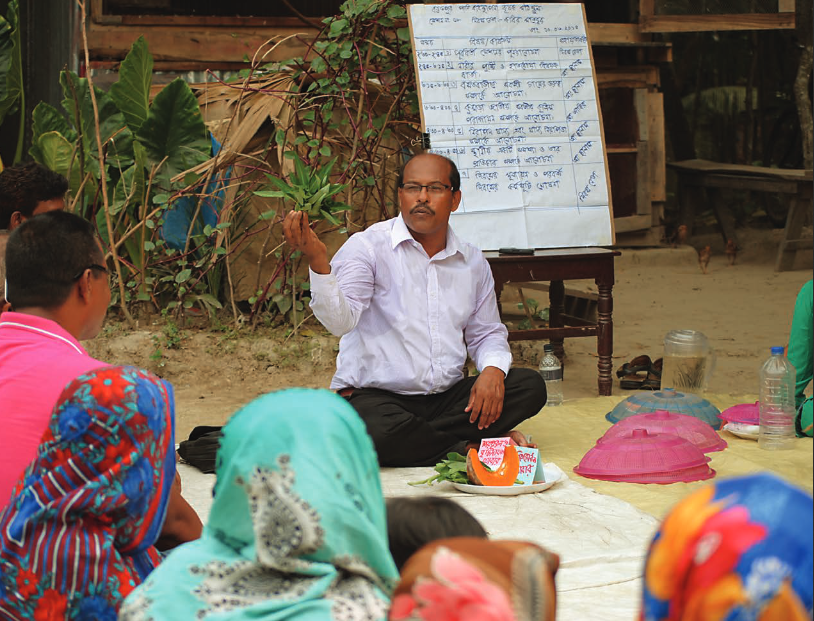
"I enjoy motivating our targeted household to grow nutritious food around the year. I feel that women have much confidence now on the messages I am conveying [to] them. Afterwards, they are practicing that ideal behavior at the household significantly which makes me proud." - Mst. Nurunnahar, Sub-Assistant Agricultural Officer, Babuganj Upazila
Funded by the United States Agency for International Development (USAID), Strengthening Partnerships, Results, and Innovations in Nutrition Globally (SPRING)/Bangladesh aims to decrease undernutrition among women and children by focusing on the 1,000-day window of opportunity (between pregnancy and 2 years of age). SPRING in Bangladesh partners with government health and agriculture staff to reach pregnant and lactating women (PLW) and children under 2 through numerous contact points in a variety of settings and through a range of interventions over a sustained period of time. The comprehensive, behaviour-centered approach to social and behaviour change communication (SBCC) comprises 3 strategic elements: coordination, capacity development, and community engagement. In 2012, SPRING began supporting the Government of Bangladesh (GOB)'s Ministry of Agriculture (MOA) by designing a 2-day training curriculum that focused on delivering tailored nutrition messages through a channel that traditionally did not provide messages on nutrition: the Department of Agricultural Extension (DAE). This analysis paper examines how SPRING expanded the multi-sectoral response to addressing malnutrition by building the capacity of agriculture workers to deliver health and nutrition messages.
SPRING has adopted the essential nutrition and hygiene actions (ENA/EHA) framework for its multi-sectoral programmatic approach. This framework outlines a set of evidence-based interventions to improve SBCC for nutrition practices during the critical 1,000 days. SPRING's SBCC framework promotes the adoption of ENA/EHA by individuals, households, groups, and communities. Although SPRING is also utilising more traditional channels to reach PLW, such as farmer nutrition schools and the Ministry of Health and Family Welfare (MOHFW), collaboration with the DAE allows them to reach other community members, such as husbands and mothers-in-law, as additional channels for effecting change in the household. Sub-Assistant Agricultural Officers (SAAO) are the frontline government agricultural staff of the DAE. As field-level professional leaders, they play a vital role in disseminating agricultural innovations and practices among farmers. SPRING builds the capacity of SAAOs and supports the GOB in the frontline implementation of nutrition services through training, regular feedback loops (e.g., coordination meetings), and joint supportive supervision with government supervisors. It is important to note that the traditional extension service approach of DAE is a type of SBCC that is also designed to transform behaviour.
Specific elements of the framework include:
- Coordination - The DAE's SAAOs work in a specific geographic area or "block" (a block covers on average 900 rural families) at the union level. They report to the Upazila Agricultural Office (UAO) and are responsible for disseminating information related to agriculture at the block level. SPRING coordinates with this cadre of staff as an additional channel for disseminating important ENA/EHA messages into the community.
- Capacity Development - SPRING/Bangladesh builds the capacity of MOA staff in 2 ways: training and supportive supervision. SPRING placed emphasis on linking nutrition messages with practical activities (e.g., producing nutritious food at the homestead level and handwashing) by providing intensive training and counseling to rural families. Trainings included strengthening counseling skills for adopting ENA/EHA and instructions on how to use our low-cost hand-washing technology, the tippy tap. Trainers conducted two-day training using a curriculum developed by SPRING for SAAOs, who then included the promotion of nutrition and hygiene practices within their normal extension work. Trained SAAOs reported using ENA/EHA messages during routine community-based group meetings.
- Community Engagement - SPRING has trained hundreds of DAE staff, which means that ENA/EHA messages are being disseminated to thousands of men and women in farmer groups. SPRING also took part in a number of agriculture fairs organised by the MOA at the upazila level to help disseminate messages on nutrition and hand washing, specifically through the use of tippy taps, and to encourage people to produce nutritious vegetables in their homesteads for consumption. SAAOs and the UAOs also participated in World Breastfeeding Week and Global Handwashing Day, among other activities.
The brief outlines the step-by-step implementation of this process, starting with the development of training curriculum. In 2012, SPRING/Bangladesh introduced The Community Worker's Guide, which explains nutrition messages in a less technical way tailored to non-heath staff and complements the information they are providing on agricultural practices. Also described here are the benefits and challenges of supportive supervision.
Results from March 2012 through September 2016 find that SPRING/Bangladesh has:
- provided over 3,000 supportive supervision visits to nearly 1,000 DAE staff;
- trained more than 1,000 agriculture staff across SPRING's 40 working upazilas in Barisal and Khulna divisions, every year providing a refresher training; and
- seen agriculture staff that were trained by SPRING recording 771,516 contacts with male and female farmers (in addition to PLW) through their ongoing farmer groups.
In conclusion: "SPRING/Bangladesh has shown how collaboration and coordination among various government departments can contribute to better nutrition....Although frontline MOA staff may have seemed like an unlikely nutrition partner at first, they have been enthusiastic about incorporating health messages into their work in rural communities across Bangladesh....We have used the Government's own contact points and identified discreet areas of opportunity within the system to rapidly scale up ENA/EHA. The consistency of our efforts to improve nutrition counseling among supervisory and frontline agriculture workers in all upazilas to improve nutrition counseling has been critical to the program's success."
SPRING website, June 8 2017.
- Log in to post comments