











































Ananya
"Multiple channels of communication will work together to create a whole that is greater than the sum of its individual parts." - BBC Media Action
The Ananya (meaning "unique") programme aims to reduce child mortality, improve maternal health, and reduce infectious diseases in Bihar, a northern state in India that has struggled with low literacy rates, high crime, and poor infrastructure and health outcomes. In May 2010, the Government of Bihar entered into a 5-year partnership with the Bill and Melinda Gates Foundation and several other partners to support the state in the areas of maternal and neonatal child health, nutrition, family planning, immunisation, infectious diseases management [diarrhoea, pneumonia, tuberculosis, and visceral leishmaniasis (VL)] and water, sanitation, and hygiene. All projects are targeted towards improving health services and shaping their demand in Bihar. Addressing critical gaps in care during the most vulnerable time of life, the partnership focuses on a thousand-day window of opportunity: from conception, through pregnancy, to the birth of a newborn baby, and to the child's second birthday. Projects include initiatives to test and implement innovative approaches and to measure and learn from the progress of each project.
- As part of the Integrated Family Health Initiative (IFHI) and in partnership with CARE, the Ananya programme focuses on village health workers such as nurse-midwives, child care workers, and trained village level health activists (ASHAs), as well as health care service providers at various facility levels.
- As part of the project "Engagement of Private Providers for Infectious Disease Management and in partnership with World Health Partners (WHP), Ananya will train and encourage private providers to offer safe, sound services, focusing on tuberculosis, diarrhoea, pneumonia, and VL. WHP's effort will cover 70% of Bihar's population.
- Population Services International (PSI) is partnering on "Supporting Sustainable Sanitation Improvements", which aims to establish a sustainable market-based supply chain for sanitation products and services.
- International Finance Corporation (IFC)'s "Government-to-Person Health Payments" project is working to improve the efficiency and transparency of payments made to health workers and programme participants.
- Noting that, for a variety of reasons (including illiteracy, traditional social barriers, or traumatic past experiences), many Biharis don't go to doctors or hospitals even if seriously ill, Ananya partner BBC Media Action is helping shape demand for quality health services and improve key household-level practices. This initiative, "Shaping Demand and Practices", draws on mass media, radio, television, newspapers, and cell phones, as well as face-to-face communication and community work. This includes involving the community in the health of mothers and newborns, aiming to not only improve survival outcomes but also to enhance accountability and equity of services across Bihar. The multi-platform approach consists of 3 complementary strands:
- Empowering community health workers: Mobile Academy and Mobile Kunji - BBC Media Action has developed 2 mobile phone services for community health services (CHWs): a training course called Mobile Academy and an on-demand service called Mobile Kunji, which is supported by a deck of cards illustrated with life-saving messages.
- Taking it to the people: mass media - What are meant to be humorous and engaging TV adverts about specific family health behaviours such as birth spacing (see below for an example) are integrated into the programme as part of: (i) Ek Teen Do (One, Three, Two), a social advertising campaign across television, radio, and outdoor sites that has been designed to persuade families to leave a 3-year gap between pregnancies. The campaign, which makes the case for the financial benefits spacing births can bring, reinforces messages being delivered by CHWs during home visits. (ii) Gaanth Baandh Lo (Tie A Knot To Remember), which reminds audiences of how to prepare when pregnant. Tying knots in a gamchha (a scarf that is ubiquitous in rural India) encourages families to remember to start planning for birth by registering for government services, saving money, and identifying a place of delivery and transport as soon as possible. These are accompanied by a 36-part long format radio programme, Khirki Mehendiwali, which focuses a fictional character called Mehendi, a vivacious young woman who is joined by a cast of characters: Phunti the tea boy and Dr. Anita, the doctor who features on the project's mobile training course and job aids for CHWs.
- Community mobilisation - 10,000 street theatre performances are designed to engage families through interactive and entertaining performances interwoven with critical and lifesaving information about family health. Also, a 2-episode edition of Khirki Mehendiwali is being discussed in 6,000 women's listeners clubs across Bihar. This is part of an effort to ensure that the programme about critical family health issues is heard by women and families in difficult-to-reach parts of the state where there is no radio reception. Each listener club is given a CD player and is run by a facilitator trained by BBC Media Action.
- As part of the "Community Mobilization and Social Accountability" project, partner Project Concert International (PCI) is creating and/or strengthening community organisations that can drive demand for better health services.
- Partner CARE is organising the "Strengthening Kala Azar Elimination Project", which is designed to support the Government of Bihar to reduce morbidity and mortality due to this disease (Kala Azar, or VL).
- Mathematica Policy Research is in charge of the "Ananya Measurement, Learning and Evaluation (MLE)" component, which involves tracking the progress of Ananya to understand which approaches work and how, as well as to estimate the overall health outcomes and impacts and to document results and lessons learned to enable replication of effective interventions in other contexts.
- COHESIVE (Collaboration for Health System Improvement and Impact Evaluation in India) is working on the "Bihar Evaluation of Social Franchising and Telemedicine" project, which focuses on the collection of experimental evidence on the performance, effectiveness, and overall impact(s) of the WHP's project (see above) to engage private providers for infectious disease management.
With the primary objective of creating awareness about Ananya, the Ananya website (no longer in operation) provides an overview of the partnership and details about all of the projects summarised above in an effort to spread its best practices to other neighbouring states. It is meant to be a source of information and learning on maternal and child healthcare, nutrition, and water and sanitation programmes and highlights the work carried out by frontline health workers, primary health centre staff, and district officials and the positive impact they have had in the district.
Maternal and Child Health
As of June 2013, the population of Bihar stands at 104 million. There are 27 million women of child-bearing age, 18.5 million children under the age of 6, and 200,000 CHWs looking after them. Bihar also has 80% of its population living in rural areas and 40% living below the poverty line. The state's newborn and maternal mortality rates are much higher than the all-India level, and Bihar has among the lowest uptake of health services in the country. According to organisers, while the government has recently made major strides in improving the state's health infrastructure, awareness of critical family health issues remain low. Despite having a right to publically funded health care, Biharis mostly seek treatment in the private sector, often from untrained practitioners in makeshift village clinics.
BBC Media Action notes that only 27% of young mothers have access to any traditional media (TV, radio, newspapers, or cinema). But 90% of them have access to mobile phones.
Government of Bihar, Bill and Melinda Gates Foundation, CARE, World Health Partners (WHP), Population Services International (PSI), International Finance Corporation (IFC), BBC Media Action, Project Concert International (PCI), CARE, Mathematica Policy Research, and COHESIVE.
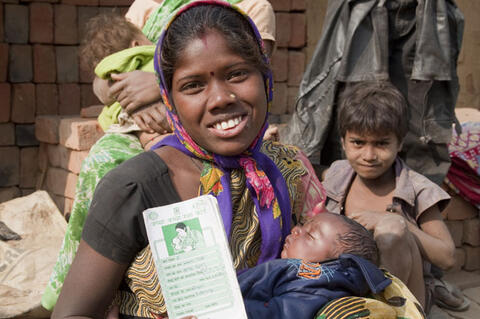
"Global Conversations on Newborn Health in India: Ananya Alliance Saves Lives", by Usha Kiran Tarigopula, Impatient Optimists", September 7 2011; "Ananya Website Launched to Promote Knowledge Sharing Across Bihar", BusinessWire India, February 1 2013; Tackling Maternal and Child Health in Bihar", BBC Media Action website, June 28 2013; Ananya website (no longer in operation), June 28 2013; and email from Emebet Wuhib-Mutungi to The Communication Initiative on April 6 2017. Image credit and caption: Impatient Optimists" - Mamda Devi, with her newborn child, Sandeep, shows her and her children's health cards outside of her home in Patna District, in Bihar.
- Log in to post comments